The Hot Breccia Property

Home / Projects / The Hot Breccia Property
Hot Breccia Project
Hot Breccia Project
Hot Breccia is a copper exploration project located in Arizona, USA, encompassing a 1,420-hectare property consisting of 227 unpatented mining claims. A recent ZTEM geophysical survey identified a large conductive anomaly adjacent to historical drilling, suggesting a potential porphyry-skarn mineralized center similar to the Resolution deposit.
Location & Accessibility
The Hot Breccia Project is a 1,420-hectare property located 5 km southeast of Freeport’s Christmas mine and 2 km from ASARCO’s Hayden smelter complex in Arizona’s Copper Belt. The property consists of 227 unpatented mining claims. The property has excellent infrastructure near paved roads and power lines, and the nearby ASARCO Hayden complex with a flotation plant and smelter, 2 km to the west. Water for drilling and exploration work is also available. The property is accessible via paved access roads such as Arizona State Highway 77 which runs along the San Pedro River and connects the town of Winkleman (7 km south) to Globe (35 km north). The nearest major city and airport is Tucson, which is approximately a 90-minute drive to the south.
Hot Breccia Project and its surrounding mines and deposits
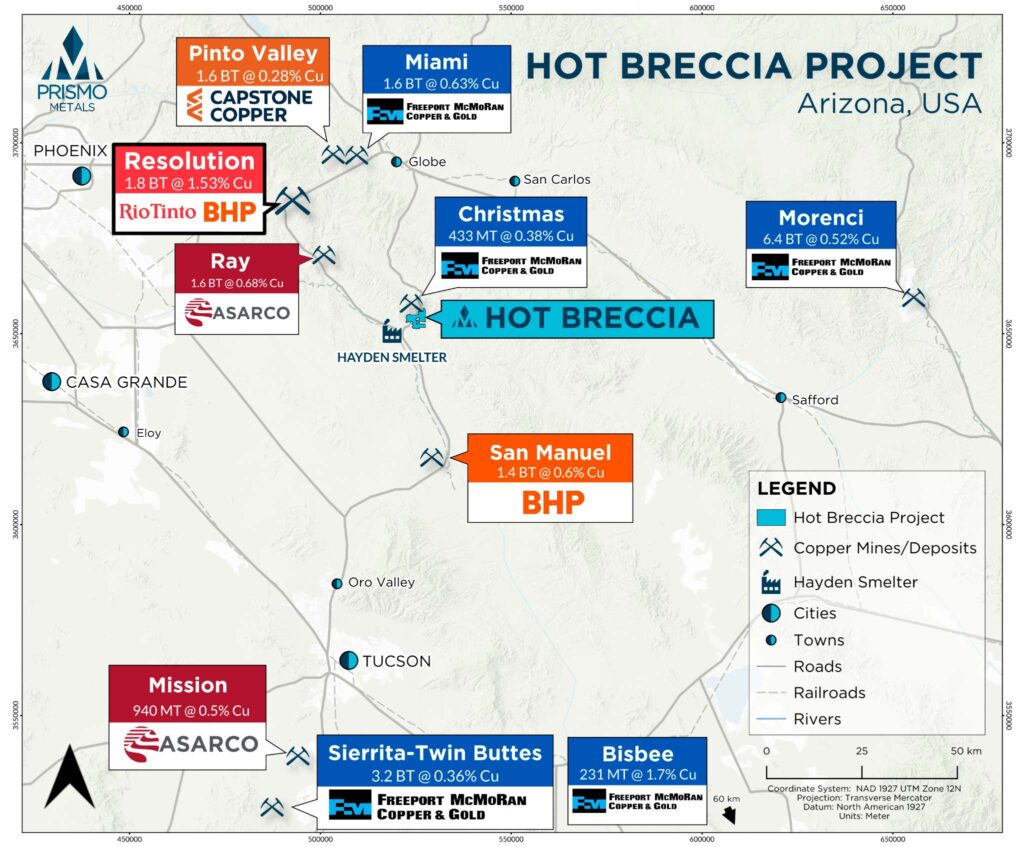
The Hot Breccia Property is located in a Tier 1 Copper Jurisdiction. Since 1910, Arizona has been the leading producer of copper in the United States. Today, 70% of U.S. copper production comes from Arizona. There are 10 major copper mines in Arizona that produce 23 to 632 million pounds of copper per year. Most of the copper mined in Arizona comes from porphyry copper deposits, with copper ore associated with intrusive igneous rocks similar to granite.
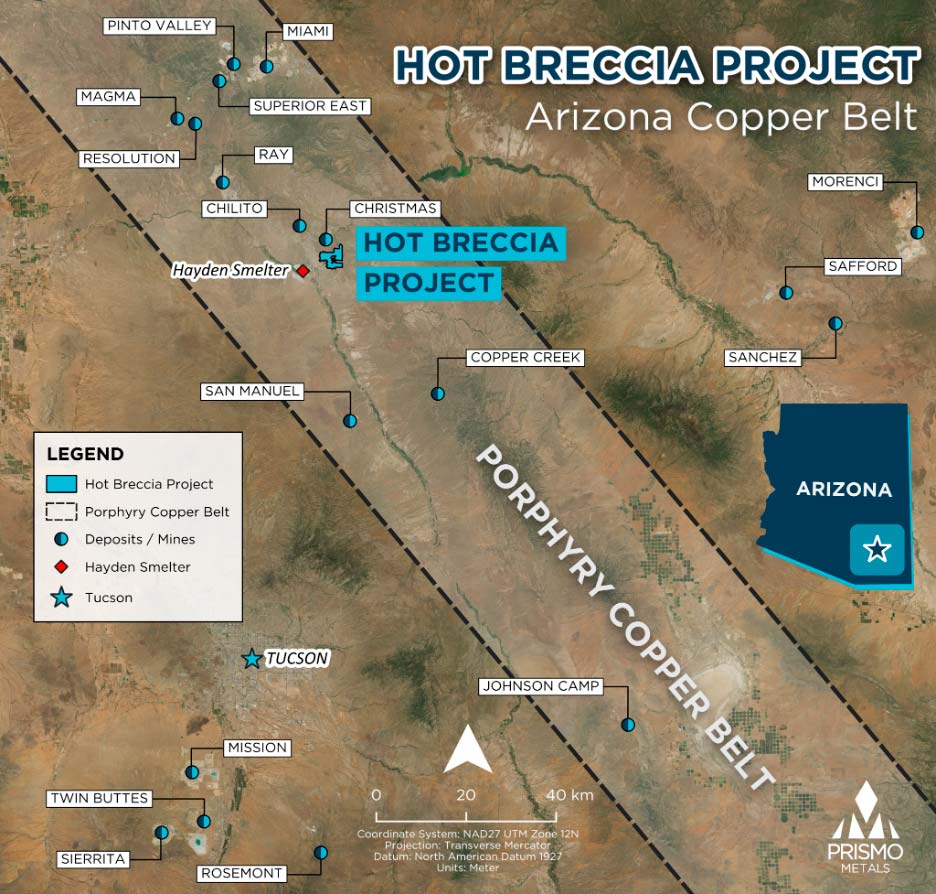
Location of the Hot Breccia Project in the Arizona Copper Belt.
Geological Setting & Mineralization
The Hot Breccia Property is located in the Banner Mining District, a mountainous zone bound on both sides by deep alluvium-filled valleys. The region is characterized by Basin & Range style morphology, consisting of high mountain ranges bounded by normal faults.
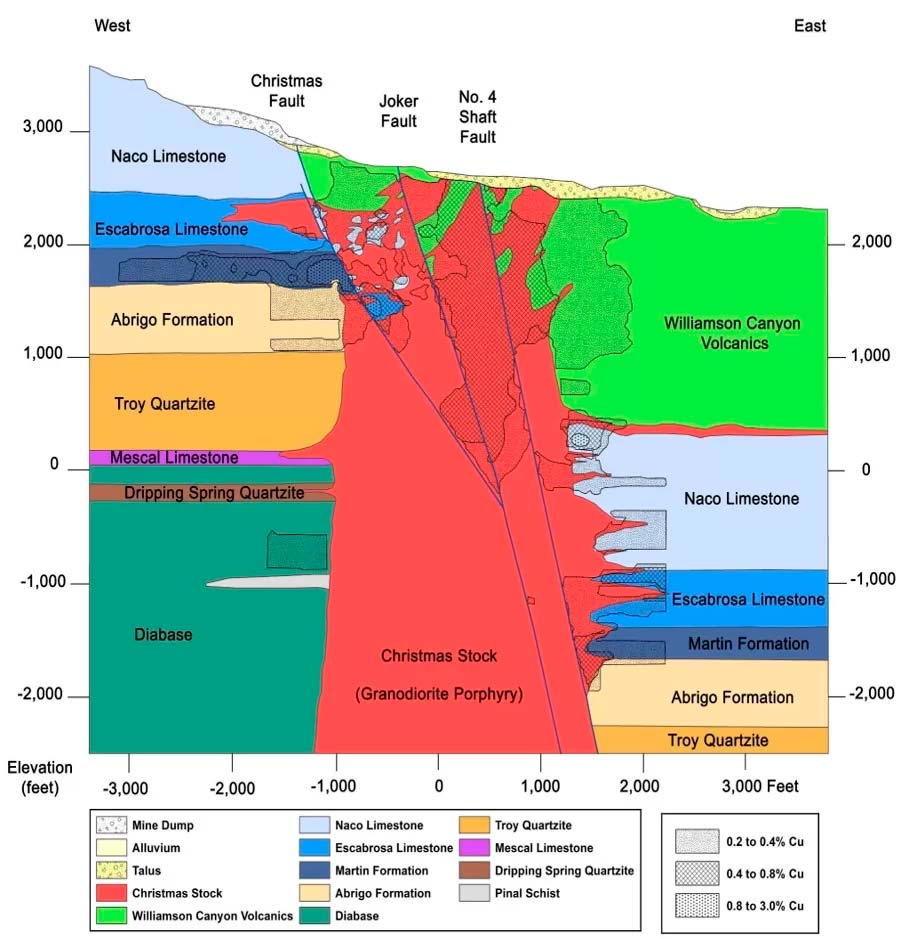
Cross-Section of the Christmas Mine area showing mineralization (geology from Briggs)
The surface outcrop, abundant across the property, is primarily upper Cretaceous-age (Laramide age) andesitic flows, clastics, and tuffs of the Williamson Canyon Formation that measure up to 2350 ft (760 m) thick. This age and type of volcanics are common around Arizona porphyries, and are often high-level volcanic piles overlying, and roughly coeval with, a causative porphyry intrusion at depth.
Below the volcanics lies a thin layer of the Cretaceous Pinkard Formation, composed primarily of siltstones and sandstones. Paleozoic carbonate and quartzite rocks below the Pinkard include the Mississippian Escabrosa Limestone, Naco Formation limestones (primary host rock for copper skarn at the Christmas Mine), and the Devonian Martin Formation. At depth, basement rocks consist of Cambrian Troy Quartzite and the Apache Group (quartzite/diabase sills/conglomerate/shale with minor limestone) atop Precambrian Pinal Schist.
Located 5 km northwest of Freeport’s past-producing Christmas mine, a porphyry copper skarn deposit hosted by the same Laramide dike swarm and within the same Paleozoic sedimentary rocks as those found at Hot Breccia. Larry Barrett, a Project Geologist for Bear Creek Mining Company, then the exploration arm of Kennecott, staked the Hot Breccia claims based on information from his 1972 Master’s Thesis. Barrett described classic surface indications for a large porphyry copper deposit at depth, including a Laramide-age dike swarm and hydrothermal breccias that cut upward through a thick Laramide volcanic pile, in some cases transporting clasts of altered Paleozoic limestone, mineralized skarn, and sulphide-bearing rock from below. Mineralized cobbles of the underlying Paleozoic rocks are also present in the overlying Cretaceous volcanic complex.
Alteration in the mineralized zone consists of dark brown garnet–magnetite skarn that progresses outward into a retrograde ore-bearing clay-calcite-quartz assemblage; very similar to descriptions of the mineralized zones at Christmas. Surface fragments found at the surface contain malachite and assayed as high as 5.7% copper. These fragments also show significant gold. The mineralization is associated with a swarm of dykes, and multiple events of mineralization are considered positive indicators for finding a potential ore deposit.
Exploration
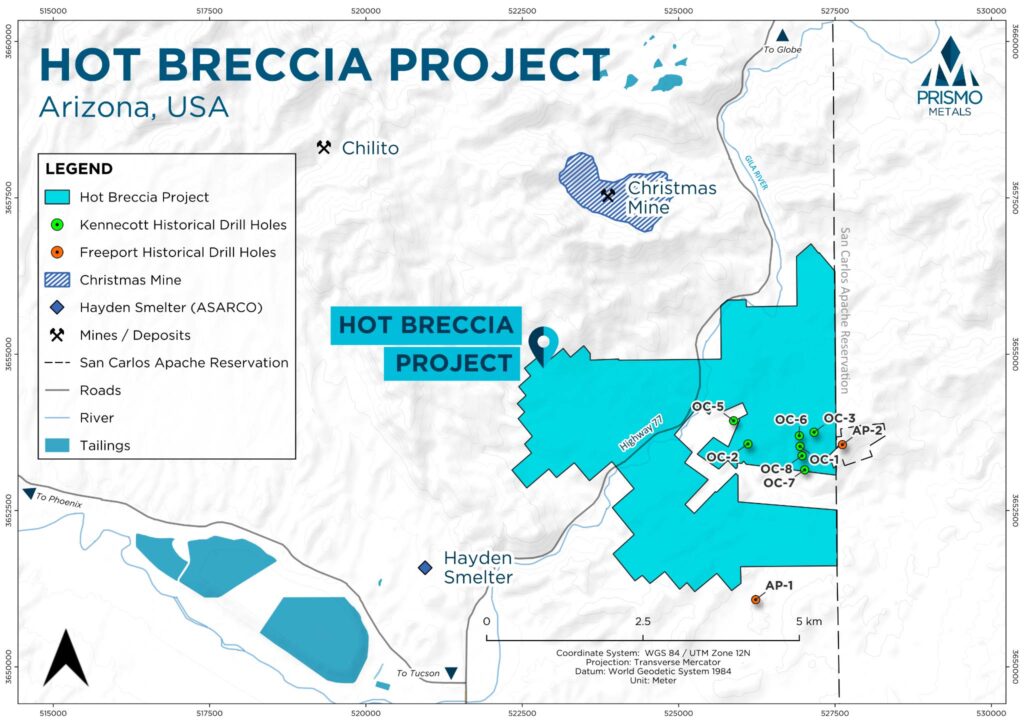
Historic drill holes at the Hot Breccia property
Kennecott drilled seven holes from 1972 to 1981, and Phelps Dodge drilled two holes on and near the current property in the same era. All drill holes reported hydrothermal alteration within the volcanics, increasing alteration intensity downwards, and Paleozoic carbonate host units have several copper intercepts reported to exceed 1% copper and elevated zinc. The northern Phelps Dodge drill hole reported 1,270 feet (387 meters) of variably mineralized skarn with several intercepts over 1% copper and a high of 3.16% copper. Prismo acquired important historical data from Bear Creek Mining Company (a Kennecott subsidiary) from 1972-1974, including complete logs and assays for hole OC-1. This data confirmed that OC-1 cut 403 meters of volcanics followed by 330 meters of quartz diorite porphyry with pyritic and copper-bearing stock, including a 23.5-meter skarn interval averaging 0.54% Cu (including 1.8 meters of 1.81% Cu).
Highlight assays for samples from Hot Breccia
Sample | Type | Sampler | Width (m) | Easting | Northing | Cu % | Au g/t |
74304 | Chip | Vendor, 1989 |
| 525,879 | 3,653,846 | – | 0.13 |
75000 | Chip | Vendor, 1989 |
| 527,574 | 3,654,602 | – | 2.1 |
84835 | Chip | Vendor, 1989 |
| 526,967 | 3,653,733 | 1.28 | 0.062 |
84836 | Selected | Vendor, 1989 |
| 526,175 | 3,652,946 | – | 18 |
84837 | Selected | Vendor, 1989 |
| 526,153 | 3,652,908 | 0.55 | 28 |
84838 | Chip | Vendor, 1989 |
| 526,054 | 3,653,161 | – | 0.125 |
84839 | Chip | Vendor, 1989 |
| 526,030 | 3,653,200 | – | 0.1 |
84841 | Chip | Vendor, 1989 |
| 525,862 | 3,653,505 | – | 0.375 |
84843 | Selected | Vendor, 1989 |
| 525,700 | 3,654,197 | – | 1.2 |
84844 | Selected | Vendor, 1989 |
| 525,665 | 3,654,294 | – | 2.4 |
84845 | Chip | Vendor, 1989 | 1.5 | 525,734 | 3,654,348 | – | 0.53 |
W147767 | Chip | Vendor, 2023 | 1.5 | 526,911 | 3,653,668 | – | 0.18 |
W147768 | Subcrop grab | Vendor, 2023 | 2 | 526,971 | 3,653,681 | 1.17 | 0.074 |
22006 | Selected | Prismo | 0.2 x 0.5 | 526,703 | 3,654,137 | – | 0.334 |
22007 | Chip-channel | Prismo | 0.5 | 526,529 | 3,653,988 | – | 0.404 |
22008 | Channel | Prismo | 1 | 526,053 | 3,652,802 | 1.11 | 3.75 |
22013 | Selected | Prismo | 1 | 526,901 | 3,653,654 | 0.21 | 0.005 |
Coordinates in WGS 84.
In July 2023, we completed an airborne ZTEM geophysical survey at Hot Breccia as part of an on ongoing exploration program. The Company has also received assay results for the first batch of samples taken at the project, that indicate the presence of not only copper mineralization, but also gold mineralization associated with gossanous veins and shear zones. See our July 11, 2023 Press Release to learn more.
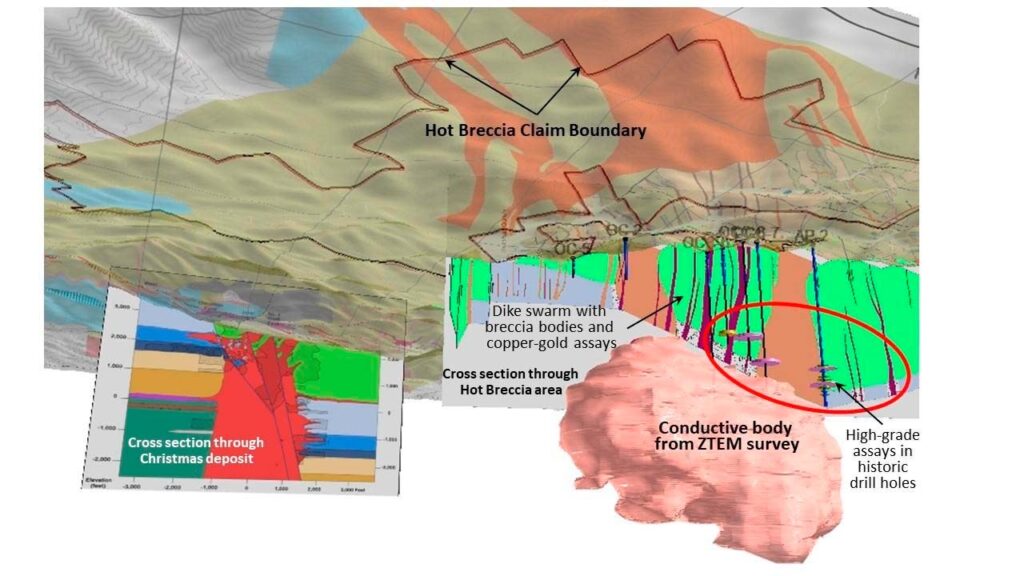
View of the subsurface at Hot Breccia looking northeasterly showing the conductive body from the ZTEM survey and cross sections of the Christmas deposit and the Hot Breccia area. Historic drill holes are shown with copper assays as disks within the red ellipse; the magenta color indicates > 1% Copper.
Prismo Metals received permit approval from the Bureau of Land Management (BLM) for ten drill pads at the Hot Breccia copper project on July 12, 2024. A bond has been posted as the final step required before proceeding, and preparatory work on existing roads from the 1970s was planned to begin shortly after permit acceptance to expedite drilling. This marks the first time in over 50 years that exploration has been activated on the property.
The Company has budgeted CA$3.0 million for a proposed 5,000-meter drill program, consisting of three to five deep drill holes. Each drill hole is anticipated to be 1,000 to 1,500 meters long, designed to drill through the entire prospective Paleozoic carbonate stratigraphy into the postulated porphyry body/breccia zone.
An Artificial Intelligence (AI) study undertaken by Exploration Technologies Inc. (ExploreTech) confirmed Prismo Metals’ exploration plan. The study identified the most likely location for a large body of sulfide mineralization, measuring 1,100 meters by 1,150 meters, in the same general area as historic drilling and the dike swarm. The AI study results support Prismo’s model and align with key features, including high-grade skarn mineralization in historic drill holes and the location of a deeper IP anomaly. The ZTEM survey identified a large conductive anomaly at depth, where limestones (normally resistive) are present, suggesting significant copper mineralization.
High-grade sampling results and the discovery of a large conductive feature, potentially a porphyry-skarn mineralized center similar to the Resolution deposit located 40 km north, reinforce our belief in Hot Breccia’s potential as we move closer to drilling.
The Hot Breccia project’s geological setting and the scale of its geophysical anomaly are reminiscent of the Resolution deposit, located 40 km to the northwest, though Hot Breccia’s prospective host rocks start shallower (400m) than Resolution’s (1,200m). The property also shows characteristics similar to the nearby Christmas Mine, a porphyry copper skarn deposit.
Latest News Releases
February 28, 2025 – Prismo Metals Updates Exploration at Hot Breccia
February 24, 2025 – Prismo Provides Corporate Update
December 2, 2024 – Prismo Metals Announces $3 Million Private Placement
October 15, 2024 – Artificial Intelligence Study Confirms Prismo Metals’ Exploration Plan at Hot Breccia
September 2, 2024 – Prismo Metals Acquires Data and Updates Model for Hot Breccia Copper Project in Arizona